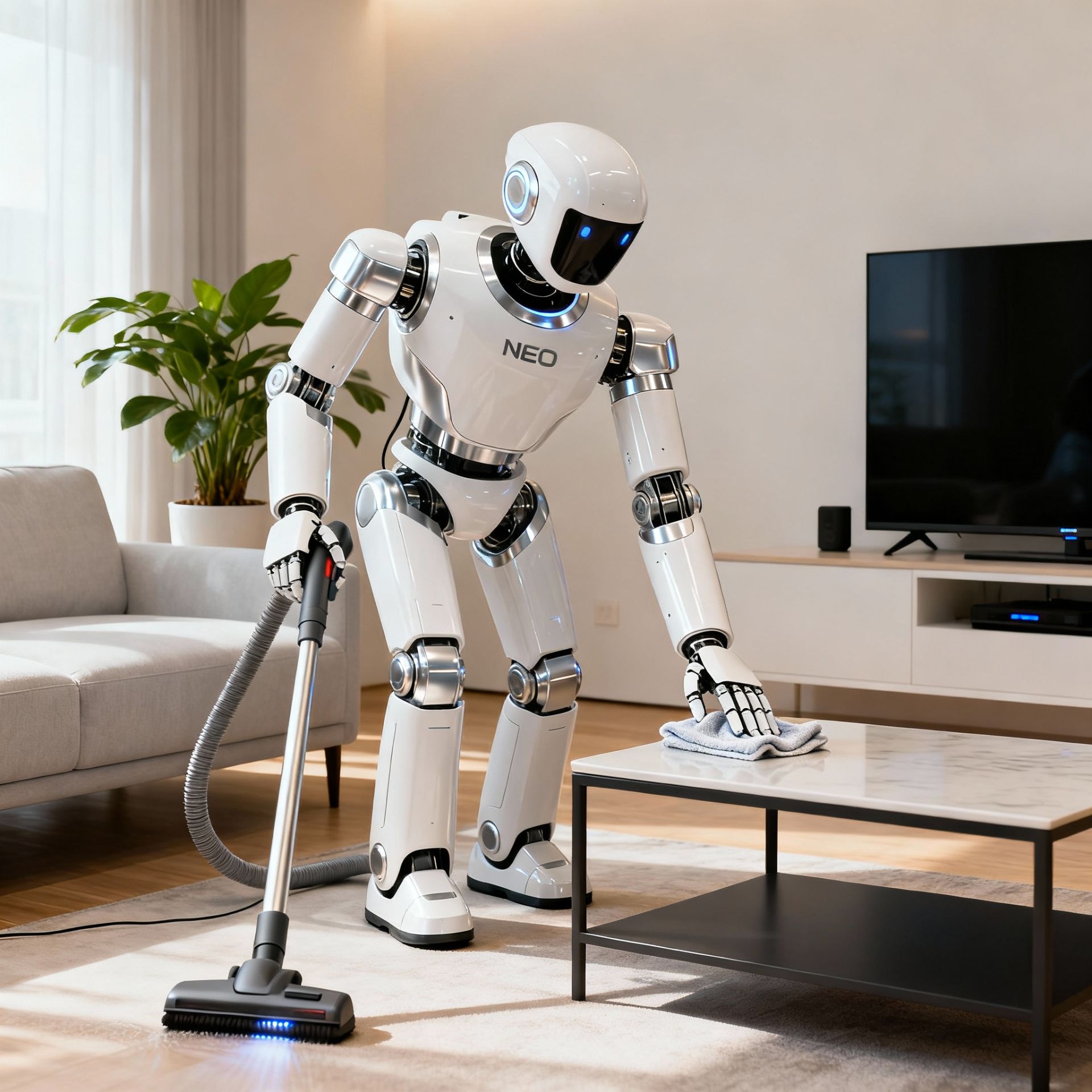
The future of household help has officially arrived—and it's wearing a knit sweater. On October 28, 2025, robotics company 1X Technologies opened pre-orders for NEO, billing it as the "world's first consumer-ready humanoid robot" designed specifically for your home. Standing at 5 feet 6 inches tall and weighing just 66 pounds, this bipedal android promises to revolutionize domestic life by tackling everything from laundry folding to dishwasher loading. But before you hand over $20,000 (or commit to the $499 monthly subscription), there's something you need to know about how NEO actually learns—and who might be watching through its camera eyes.
Meet NEO: Your New AI-Powered Housekeeper
NEO isn't just another smart home gadget—it's a fully mobile humanoid robot engineered to navigate the unpredictable chaos of real homes. Wrapped in a soft, customizable exterior available in Tan, Gray, and Dark Brown, the robot sports a knit suit and shoes designed to help it blend seamlessly into your living space. Think of it as the anti-Terminator: friendly, approachable, and deliberately non-threatening.
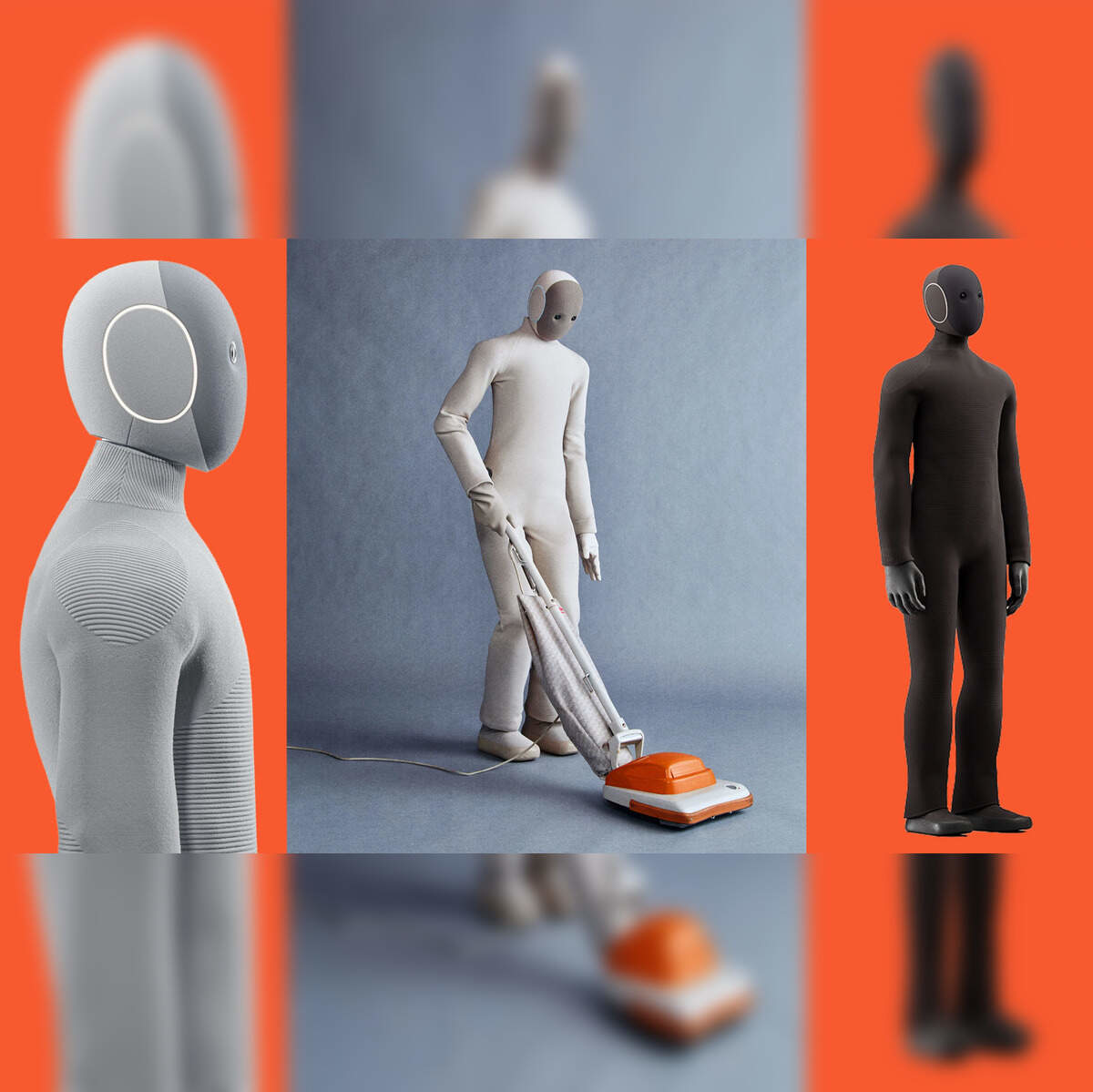
The robot's capabilities are genuinely impressive. NEO can lift up to 154 pounds and carry 55 pounds while maintaining a whisper-quiet operation at just 22 decibels—quieter than your refrigerator humming in the background. Its five-fingered hands feature an astounding 22 degrees of freedom, giving it human-level dexterity to handle delicate tasks like stacking wine glasses or folding your favorite sweater without wrinkling it.
Powered by NVIDIA's Jetson Thor chipset, NEO packs up to 2,070 FP4 TFLOPS of AI computing power directly onboard. The robot operates on an 842-watt-hour battery that provides approximately four hours of runtime, with quick charging capabilities that deliver one hour of operation for every six minutes of charging. When the battery runs low, NEO autonomously navigates to its charging dock and plugs itself in—no babysitting required.
The Revolutionary Technology Behind the Soft Robot
What truly sets NEO apart from industrial-grade humanoids is 1X's patented Tendon Drive system. Instead of using traditional rigid harmonic gears found in factory robots, NEO employs a biomimetic approach inspired by human musculature. High-torque density motors—which 1X claims are "the highest on Earth"—drive flexible tendon-based transmissions that create smooth, compliant movements.
This engineering philosophy results in several breakthrough advantages. The tendon-driven design allows NEO to achieve 95% backdrivability, meaning its joints can move fluidly in response to external forces rather than rigidly resisting them. This makes physical interaction with NEO inherently safer than bumping into a traditional industrial robot with stiff, heavy limbs.
The robot's entire body is covered in a custom 3D lattice polymer structure that functions as a soft, impact-absorbing skin. There are no exposed pinch points where fingers could get caught, and the compliant design means that even if NEO falls, the risk of injury to nearby humans or pets is minimized. The Head Injury Criterion (HIC) rating comes in below 250, indicating the robot meets rigorous safety standards for human interaction.
NEO's hands are rated IP68 waterproof, meaning they can be fully submerged in water for washing dishes or cleaning surfaces. The rest of the body carries an IP44 splash-proof rating, protecting against water splashes during household tasks.
Redwood AI: The Brain That Learns From Reality
The intelligence driving NEO is Redwood AI, 1X's proprietary vision-language model specifically trained for household manipulation tasks. Unlike chatbots that only understand text, Redwood is a multimodal transformer that seamlessly integrates language control, whole-body locomotion, and dexterous manipulation into a single neural network.
What makes Redwood particularly powerful is its training methodology. The AI model has been trained on real-world data collected from 1X's fleet of EVE industrial robots and NEO prototypes deployed in actual environments. This means Redwood doesn't just simulate household tasks—it has experienced them firsthand, learning from thousands of hours of real physical interactions.
The system demonstrates impressive generalization capabilities. Redwood can handle variations in tasks and interact confidently with unfamiliar objects it hasn't explicitly seen during training. For example, if NEO has learned to open one type of door, it can apply that knowledge to different door handles, weights, and mechanisms. When initial attempts fail, the AI exhibits learned behaviors like selecting a different hand approach or adjusting its grip strategy.
Redwood integrates whole-body and multi-contact manipulation, meaning NEO coordinates its legs, torso, arms, and hands simultaneously. This allows the robot to brace itself against surfaces, lean into tasks for better leverage, and maintain balance while manipulating heavy or awkward objects. The AI runs entirely on NEO's onboard embedded GPU at approximately 5 Hz with around 160 million parameters, eliminating the need for constant cloud connectivity for basic operations.
For conversational interaction, NEO also features a built-in large language model (LLM) that handles voice control. This off-board system interprets natural language commands and conversational context in real-time, predicting user intent from voice input. You can literally talk to NEO like a person, asking it to "put the dishes away" or "fold the laundry in the bedroom," and it understands what you mean.
What NEO Can Actually Do (And What It's Learning)
Out of the box, NEO arrives with a baseline set of autonomous capabilities. From day one, it can handle fundamental tasks like opening doors for guests, fetching items from other rooms, turning lights on and off, and navigating through familiar spaces in your home. As 1X releases software updates trained on data from thousands of deployed units, NEO's skill set continuously expands without requiring any action from the owner.
The robot's Audio Intelligence system uses four beamforming microphones to interpret audio cues and conversational context, knowing when it's being addressed versus background conversation. Its Visual Intelligence leverages dual 8.85-megapixel fisheye cameras operating at 90 Hz to understand spatial environments and recognize objects. NEO can identify ingredients on your kitchen counter and suggest recipe ideas, demonstrating contextual awareness that goes beyond simple object recognition.
Perhaps most intriguingly, NEO features persistent memory that retains information to personalize your experience over time. It remembers your preferred cleaning schedules, dietary habits, and even tracks the progress of ongoing projects or hobbies. This continuity means you don't have to re-explain your household routines every single time—NEO learns and adapts to your lifestyle.
The robot also doubles as a mobile entertainment system thanks to its three-stage speaker setup in the pelvis and chest area. With built-in WiFi, Bluetooth, and 5G connectivity, you can stream music throughout your home as NEO moves from room to room.
The Privacy Trade-Off: Expert Mode and Human Operators
Here's where things get complicated—and controversial. While NEO can handle basic autonomous tasks, the robot's AI still needs substantial real-world training data to master complex or novel household chores. To bridge this gap, 1X has implemented "Expert Mode," a teleoperation system that allows human operators from the company to remotely control your NEO through a VR headset and controllers.
In a remarkably candid interview with The Wall Street Journal, 1X CEO Bernt Børnich explained the trade-off: "If we don't have your data, we can't make the product better". Early adopters who receive NEO units in 2026 must agree to a "social contract" where human teleoperators can see inside their homes through the robot's cameras during scheduled training sessions.
This isn't occasional remote assistance—according to WSJ's hands-on testing at 1X headquarters, 100% of the work NEO performed was completely teleoperated through Expert Mode. The promo videos carefully specify that only two tasks—answering the door and taking a cup away—are currently autonomous. Everything else you see NEO doing in promotional materials likely involves a human operator controlling it remotely.
To address the obvious privacy concerns, 1X has implemented several safeguards. Owners control when teleoperators can access the robot through a mobile app, specifying exact times and tasks. You can designate no-go zones in your home that operators cannot enter, and the company promises to blur humans in the video feed to protect identity. NEO's Emotive Ear Rings light up to visually indicate when a human operator is in control, providing transparency about the robot's operational mode.
Still, the fundamental privacy question remains: Are you comfortable with 1X employees seeing the interior of your home, even during scheduled sessions with consent and blurred faces? For many potential buyers, this represents a significant barrier—trading domestic privacy for cutting-edge technology.
How Much Does NEO Actually Cost?
1X offers two purchasing models for NEO, both requiring a refundable $200 deposit to secure your place in line:
Outright Purchase: $20,000 for full ownership with priority delivery in 2026. This one-time payment makes you an early adopter who'll receive the very first production units.
Subscription Model: $499 per month for ongoing access. While more expensive over time ($5,988 annually), this option lowers the barrier to entry and may appeal to those who want to test the technology before committing to full ownership.
U.S. customers can pre-order now with deliveries beginning in 2026. International expansion to other markets is planned for 2027. The company aims to ship thousands of units in 2026, scaling to potentially millions by 2028 as manufacturing capacity ramps up.
To put the pricing in perspective, NEO's $20,000 price tag positions it as a luxury early-adopter product. Tesla's Optimus humanoid is targeting affordability with projections eventually reaching the $20,000-$30,000 range at scale, while Chinese manufacturers are already announcing humanoid models below $10,000. However, NEO is the first consumer-focused humanoid actually available for pre-order right now, not vaporware scheduled for some undefined future date.
NEO vs. The Competition: How Does It Stack Up?
The humanoid robotics market is experiencing explosive growth in 2025, with unprecedented investment and rapid technological progress converging to push the industry from research labs into commercial reality.
Tesla Optimus: Standing 5 feet 8 inches and weighing significantly more than NEO, Optimus focuses on industrial applications with ambitions for home deployment. Tesla is targeting 5,000 units in 2025, scaling to 100,000 by 2026. Optimus currently has 11 degrees of freedom in its hands, though Tesla plans to upgrade to 22 degrees matching NEO. While Optimus has impressive capabilities demonstrated in factory settings, it hasn't yet opened consumer pre-orders with firm delivery dates.
Figure 03: This humanoid emphasizes deep AI integration with advanced neural intelligence and cognitive systems. Figure 03 excels in fluid motion and reasoning capabilities, positioning itself for long-term scalability across multiple industries. However, its focus remains primarily on workplace applications rather than home deployment.
Boston Dynamics Atlas: The electric version of Atlas represents cutting-edge robotics with extraordinary agility and strength. However, Boston Dynamics has consistently focused on industrial and research applications with no consumer product on the horizon.
NEO's competitive advantage lies in its home-first design philosophy. While competitors are pivoting from industrial settings toward eventual consumer applications, 1X designed NEO from the ground up specifically for the unstructured, unpredictable environment of real homes. The soft body design, quiet operation, lightweight construction, and conversational AI interface all reflect this domestic focus.
According to reported specifications, NEO would also be the fastest humanoid robot in the world with a maximum speed of 6.2 meters per second (just under 14 mph)—twice as fast as Beijing's Tiangong humanoid that won the world's first humanoid robot half marathon. However, 1X hasn't publicly demonstrated NEO running at top speed or lifting at maximum capacity, so these claims await independent verification.
The Broader Implications: What This Launch Really Means
NEO's launch represents a pivotal inflection point in the consumer robotics industry. For the first time, a fully mobile humanoid robot designed specifically for households is available with explicit pricing, delivery timelines, and a functional (if limited) product—not just aspirational concept videos.
The humanoid robotics market is projected to grow from $2.02 billion in 2024 to $15.26 billion by 2030, representing a staggering 39.2% compound annual growth rate. Investment has accelerated dramatically, with China alone recording over 610 robotics investment deals totaling $7 billion in the first nine months of 2025—a 250% increase year-over-year.
Manufacturing costs for humanoid robots have plummeted from $50,000-$250,000 per unit to $30,000-$150,000, declining 40% annually instead of the expected 15-20%. This rapid cost reduction, combined with urgent labor shortages in manufacturing, healthcare, and service industries worldwide, is accelerating commercial viability faster than most analysts predicted.
1X Technologies has raised over $125 million in funding, including a $23.5 million Series A2 round led by OpenAI's Startup Fund in March 2023 and a $100 million Series B round led by EQT Ventures in January 2024. The company is currently in talks for up to $1 billion in new funding at a targeted valuation of at least $10 billion—more than 12 times its January 2024 valuation.
Founded in 2014 by CEO Bernt Børnich as Halodi Robotics and rebranded to 1X in 2022, the company has evolved from developing wheeled industrial androids to focusing exclusively on bipedal home robots. This strategic pivot recognizes that the home environment, while more challenging than structured factory floors, offers a clearer path to gathering the diverse training data necessary for general-purpose AI.
The Verdict: Revolutionary Technology With Growing Pains
NEO undeniably represents a remarkable engineering achievement and a genuine step toward the sci-fi future we've imagined for decades. The combination of tendon-driven biomimetic actuation, soft compliant design, multimodal AI, and home-optimized specifications demonstrates that 1X has thought deeply about what it actually takes for a humanoid robot to coexist safely and usefully with humans in domestic spaces.
The robot's ability to lift more than twice its body weight while operating more quietly than a refrigerator is genuinely impressive. The 22-degree-of-freedom hands with waterproof rating enable delicate manipulation that previous home robots simply couldn't achieve. The persistent memory and conversational AI create an interaction model that feels natural rather than mechanically rigid.
However, the current reality of NEO's capabilities doesn't quite match the aspirational marketing. The heavy reliance on teleoperation through Expert Mode means early adopters are essentially paying $20,000 to become beta testers who contribute training data while humans remotely operate the robot. The privacy trade-offs, while disclosed, remain substantial—you're inviting 1X employees to see inside your home during training sessions, even with consent controls and blurring safeguards.
For those comfortable with these limitations and excited to be on the cutting edge of robotics history, NEO offers a unique opportunity to participate in shaping this emerging technology. The robot will genuinely improve over time as AI models are trained on data from thousands of deployed units. Software updates will continuously expand capabilities without requiring hardware upgrades.
For mainstream consumers expecting a fully autonomous household assistant that "just works" out of the box, NEO probably isn't ready yet. The technology is real, functional, and advancing rapidly—but it's still in an early, iterative phase that requires patience, acceptance of limitations, and willingness to be part of the training process.
The question isn't whether humanoid home robots will eventually become commonplace—the trajectory is clear. The question is whether 2026 is the right time for you to adopt this technology, with all its current capabilities and limitations, at a $20,000 price point.