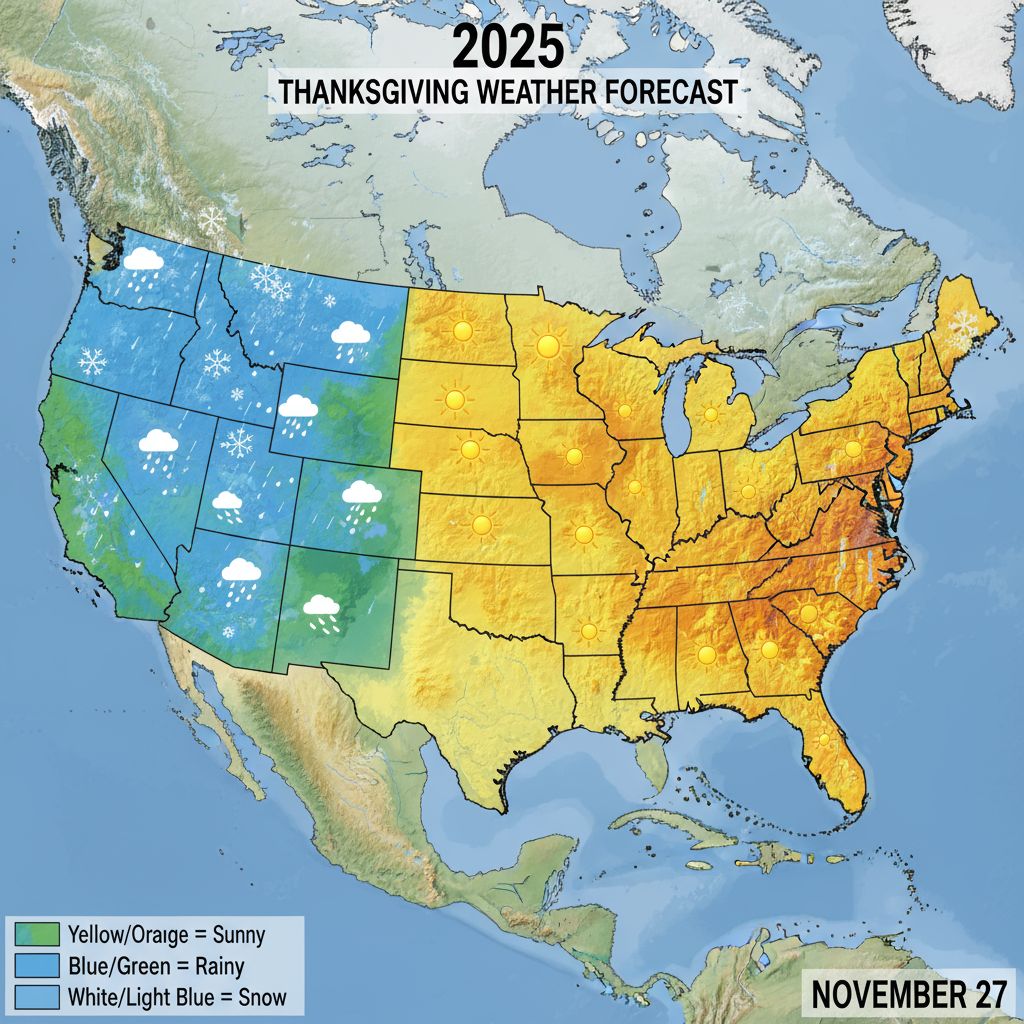
Thanksgiving is just around the corner, and if you're planning your holiday travels, you'll want to know what Mother Nature has in store. This year's Thanksgiving falls on Thursday, November 27, 2025, and according to The Old Farmer's Almanac, travelers can expect a diverse mix of weather conditions across the United States. Whether you're heading east or west, north or south, understanding what's coming your way can help you pack smart and plan your route strategically.
The Big Picture: A Diverse Holiday Week
The Old Farmer's Almanac describes Thanksgiving week 2025 as "a patchwork of weather across the U.S."—and that's exactly what makes this forecast so important for the nearly 80 million Americans expected to travel at least 50 miles from home during the holiday week. According to AAA projections, approximately 71.7 million people will travel by car, making this potentially the busiest Thanksgiving travel period on record.
The forecast breaks down like this: sunny skies will dominate much of the East, while the West Coast braces for wet conditions. Limited snowfall is anticipated in northern regions, including northern New England, the Upper Midwest, elevated areas of the Intermountain West, and Alaska.
Regional Breakdown: Where You're Headed Matters
The Old Farmer's Almanac divides the United States into 18 distinct climate regions to provide more granular forecasts. Here's what to expect in your neck of the woods:
Northeast & New England
Conditions: Colder than average with sunny skies and possible light snow in the northern parts
Travelers heading to New England can expect crisp, cold, and mostly sunny conditions—perfect for autumn scenery but bring layers! The southern parts of the region should enjoy bright and clear weather by Thanksgiving Day, though temperatures will be chilly. Northern New England may see a few snowflakes, so pack accordingly if you're heading to Vermont, Maine, or New Hampshire.
Great Lakes, Ohio Valley & Midwest
Conditions: Light snow early in the week, clearing for Turkey Day
The Ohio Valley and Great Lakes region might see some early-week moisture and scattered showers, but forecasters expect conditions to improve by Thanksgiving Day with fair, clear skies. This is good news for those driving through Ohio, Michigan, Indiana, Kentucky, Illinois, and Wisconsin. Just watch for brief light snow across the Great Lakes and Ohio Valley early in the Thanksgiving week.
Southeast
Conditions: Mild temperatures with clear skies
Southern travelers are in for a treat—the Southeast is expected to experience relatively mild weather with predominantly sunny and dry conditions. The week may start with quick changes between rain and sun, but by Thanksgiving Day, clear skies should prevail across Tennessee, Virginia, North Carolina, South Carolina, Georgia, Alabama, Mississippi, and Florida.
North Central & Rockies
Conditions: Scattered light snow, especially in elevated areas
The Plains and Rocky Mountain regions might see scattered light snow, particularly in elevated terrain. Montana, Wyoming, Colorado, and the Dakotas could experience "flaky" conditions, though this snow is generally expected to be light. The High Plains will see colder-than-average temperatures throughout the week.
South Central
Conditions: Generally unsettled with light snow in higher elevations
Arkansas, Louisiana, Oklahoma, and New Mexico can expect generally unsettled conditions. Texas presents a mixed picture—fair conditions followed by rain, then clearing. However, the general trend is warmer air persisting over Texas and the Desert Southwest.
West Coast
Conditions: Wet with heavy rainfall; the wettest region of the country
This is the biggest travel concern this Thanksgiving. The Pacific Northwest (Washington, Oregon, and Idaho) will experience showery, unsettled conditions. California and Nevada will see scattered showers, while the southern Pacific Northwest braces for heavier rainfall. If you're flying or driving to the West Coast, bring rain gear and be prepared for potential travel delays.
Southwest
Conditions: Mixed with light snow possible in Nevada and Utah
California, Nevada, Utah, and Arizona can expect problematic weather in some areas. Light snow is possible in higher elevations of Nevada, Utah, and parts of Arizona. The region will experience a temperature rollercoaster—from fair conditions to cold snaps.
Temperature Trends: Warm South, Cool North
Beyond precipitation, temperatures will vary significantly across the country:
Warmest regions: Texas, the Desert Southwest, and the Deep South will enjoy warmer-than-average air
Coldest regions: New England, the High Plains, and much of the Western U.S. will experience cooler-than-average temperatures
This temperature split means travelers should pack versatile clothing—layers are your friend this Thanksgiving.
Travel Safety Tips for Thanksgiving Weather
With nearly 80 million people on the roads and in the air, here's what you should do before and during your travels:
Before You Leave:
Check your vehicle's condition (tire pressure, fluid levels, windshield wipers)
Verify weather conditions along your route and at your destination
Pack an emergency kit with blankets, first aid supplies, and jumper cables
Keep your gas tank at least half full
Rest well before traveling—fatigue is a serious risk factor
On the Road:
Avoid peak travel times (Wednesday afternoon and Sunday after Thanksgiving are historically the busiest)
Buckle up and follow speed limits
Slow down in adverse weather
Increase your following distance
Use your headlights in poor visibility
Take frequent breaks and rotate drivers
If Winter Weather Strikes:
Stay with your vehicle if stranded
Tie a bright cloth to your antenna so rescuers can locate you
Stay alert and focused on driving
Understanding the Old Farmer's Almanac: How Accurate Is It?
Since its founding in 1792, The Old Farmer's Almanac has been a trusted resource for long-range weather forecasts. The publication claims an impressive 80% accuracy rate, though independent studies suggest a more modest 50-52% accuracy rate compared to modern meteorological forecasting.
The Almanac uses a proprietary formula combining solar science, climatology, and meteorology. While the exact methodology remains a closely guarded secret, it considers factors like:
Sunspot activity and solar cycles
Planetary positions
Tidal action
Historical weather patterns
Modern climate data
The key takeaway: The Almanac excels at providing broad seasonal trends rather than pinpoint forecasts. It can reliably indicate whether a season will be warmer, colder, wetter, or drier than average—but it's not a replacement for daily local weather forecasts from the National Weather Service.
Frequently Asked Questions
Looking Ahead: Winter 2025-26 Forecast
As if one holiday forecast wasn't enough to think about, The Old Farmer's Almanac has also released its winter 2025-26 forecast, describing it as "mostly mild—with pockets of wild." This means:
Near-normal to mild temperatures across many areas
Colder-than-average conditions in select regions
Above-average precipitation in the northern Plains, Great Lakes, and Pacific Northwest
Drier conditions expected across much of the South and Southwest
The 2025-26 winter is shaping up to be interesting, with forecasters predicting early winter storms in the Midwest and Northeast by late November, potentially bringing heavy snow to areas like Buffalo, New York (projected 90-100 inches).
The Bottom Line
Thanksgiving 2025 promises a classic American holiday weather pattern—diverse, unpredictable, and absolutely manageable with the right preparation. Whether you're heading east for sunny skies, west for rain, or north for potential snow flurries, the key to a smooth holiday is planning ahead.
Check your local weather forecast, prepare your vehicle, give yourself extra travel time, and remember: arriving safe and slightly late beats the alternative. The folks at the Old Farmer's Almanac have been predicting weather for over 230 years for a reason—they know that preparation is the best defense against Mother Nature's surprises.
Safe travels, and happy Thanksgiving!