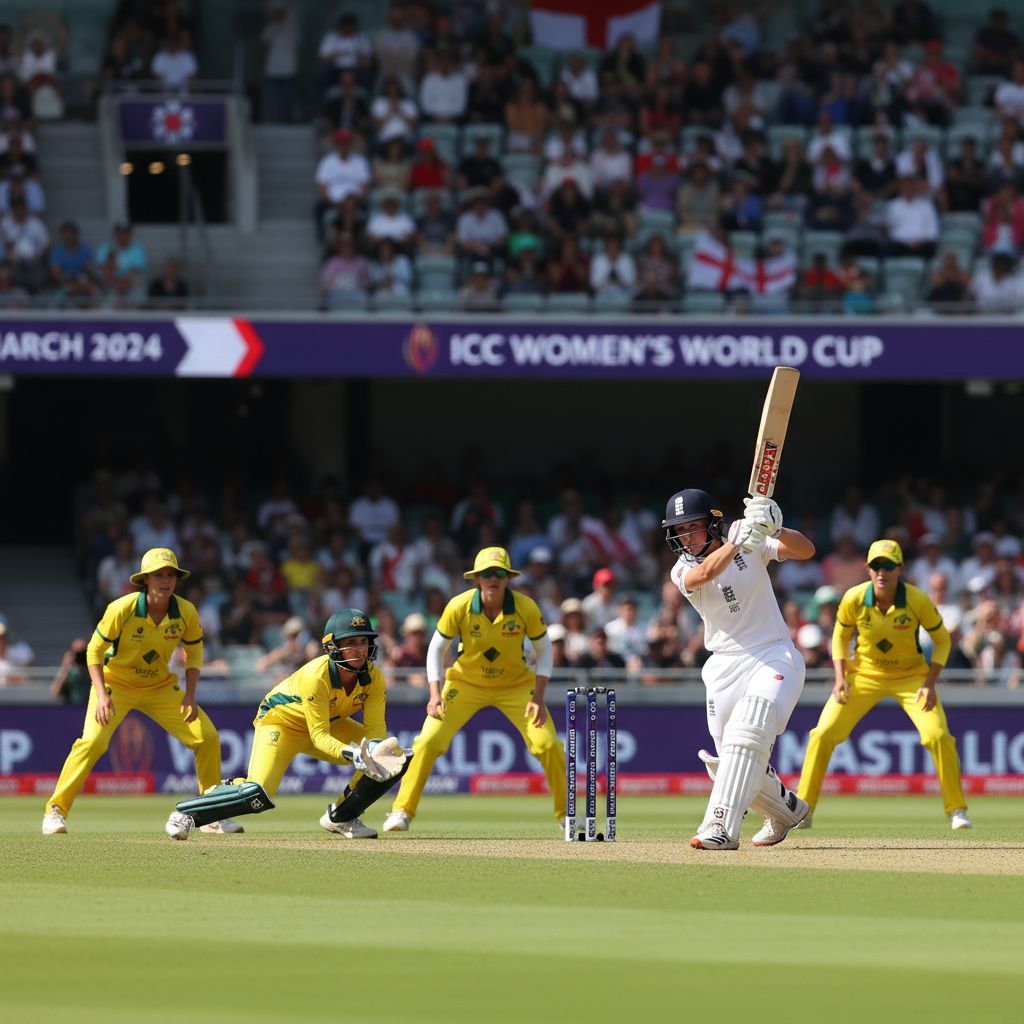
In a highly anticipated clash that had cricket fans on the edge of their seats, England Women faced Australia Women at the Holkar Cricket Stadium in Indore on October 22, 2025, marking one of the most significant encounters of the ICC Women's World Cup. Both teams entered the match undefeated in the tournament, setting the stage for a classic rivalry showdown that would determine top spot in the group standings.
The Revenge Narrative: England's Road to Redemption
The backstory to this encounter was impossible to ignore. Just ten months earlier, England had suffered their most humiliating defeat in recent memory—a comprehensive 16-0 whitewash across all formats in the Women's Ashes. That devastating loss triggered a complete overhaul of England's leadership structure, with Jon Lewis stepping down as coach and Heather Knight relinquishing the captaincy.
Enter Charlotte Edwards, the legendary former England captain who took over as head coach in April 2025. Under her guidance, alongside new captain Nat Sciver-Brunt, England embarked on a transformation journey that saw them dominate the early stages of the World Cup.
"No, it hasn't been a topic of discussion," Amy Jones stated emphatically when asked about the Ashes whitewash ahead of the Australia clash. "I think it's quite easy to look past it, only because a lot of time has passed, and a lot of changes have happened since then. It's got a really different feel about it."
Amy Jones: The Resurgent Opener
One of Charlotte Edwards' most impactful decisions was moving Amy Jones back to the top of the batting order—a position she hadn't occupied regularly for England since 2019. The 32-year-old wicketkeeper-batter from Sutton Coldfield had endured a frustrating wait for her first international century, which finally arrived after 12 years and more than 200 appearances.
That breakthrough came in spectacular fashion against West Indies in June 2025, when Jones smashed 122 runs in Derby, followed by another century just days later. The back-to-back hundreds made Jones and opening partner Tammy Beaumont the first openers in Women's ODI history to register two consecutive 200-plus partnerships.
"I've loved opening again," Jones revealed in the lead-up to the Australia match. "It was a bit of a surprise when Lottie (Charlotte Edwards) first mentioned it to me after a few years of not doing it for England. It's something I really enjoy."
Jones' return to form came at the perfect time. At the World Cup, she had already notched a crucial half-century against India, demonstrating the composure and attacking intent that Edwards had instilled in her team.
The Match: Battle of the Unbeaten Giants
Australia captain Alyssa Healy was ruled out of the match with a minor calf strain suffered during training, handing the leadership reins to vice-captain Tahlia McGrath. Georgia Voll stepped in to open alongside Phoebe Litchfield, while Beth Mooney took over wicketkeeping duties.
McGrath won the toss and elected to field first, citing the potential for dew later in the evening and the bit of grass on the wicket. "We're pretty happy to chase under lights," McGrath explained at the toss.
England's innings began promisingly as Jones and Beaumont got off to a rollicking start, finding gaps early and putting the Australian bowlers under pressure. The opening partnership reached 55 before Annabel Sutherland delivered the breakthrough, bowling a beauty that nipped back through Jones' defense to crash into the off stump.
Jones departed for 18 off 26 balls, a modest contribution but one that set the platform for England's innings. Beaumont continued to anchor the innings, reaching her half-century with an impressive array of boundaries. However, Australia's bowlers struck at regular intervals to prevent England from posting a massive total.
Heather Knight fell lbw to Sophie Molineux for 20 after a successful DRS review by Australia, while captain Nat Sciver-Brunt was dismissed for just 7, caught at mid-off by Sutherland off Alana King's bowling. Beaumont fought valiantly, scoring 78 runs before being caught brilliantly by Georgia Voll at long-on, who had to backpedal to the boundary, take the catch above her head, then lob the ball back into play while losing her balance.
England's middle order struggled to build momentum. Emma Lamb was bowled by Sutherland's clever back-of-the-hand slower ball for just 7, while Sophia Dunkley suffered an ugly dismissal, stumped for 22 after completely misjudging the flight.
Alice Capsey and Charlie Dean provided late resistance, with Capsey's aggressive 31 off 27 balls and Dean's unbeaten 19 off 21 balls helping England reach 212 for 6 in 46 overs. Annabel Sutherland was the pick of the Australian bowlers with 3 for 50, while Alana King, Sophie Molineux, and Ashleigh Gardner each claimed a wicket.
Australia's Clinical Chase
The defending champions approached their chase with characteristic confidence and precision. Despite the absence of their captain and leading run-scorer Healy, Australia had the firepower in their batting lineup with Ellyse Perry, Beth Mooney, and the in-form Phoebe Litchfield.
Perry, one of the greatest all-rounders in women's cricket history, had already etched her name in the record books with a remarkable 213 not out against England in the 2017 Ashes Test. Mooney, who earlier in 2025 became the first Australian woman to score a century in all three international formats, brought invaluable experience to the middle order.
The match represented more than just group stage positioning—it was a psychological battle ahead of the knockout stages. Both teams had already secured their semifinal spots with nine points each, but the winner would claim top spot in the standings and carry crucial momentum into the business end of the tournament.
The Bigger Picture: Tournament Dynamics
England's journey to this point had been remarkable considering their recent struggles. After the Ashes debacle, they opened their World Cup campaign with a dominant 10-wicket victory over South Africa, bowling them out for a mere 69. They then survived a challenging chase against Bangladesh before registering a comprehensive 89-run win over Sri Lanka.
A rain-affected washout against Pakistan could have been disastrous—England were struggling at 79 for 7 before the weather intervened. Edwards admitted afterward: "We got away with it". But the team showed true championship character by bouncing back with a thrilling four-run victory over co-hosts India, with Knight's masterful century setting up the win.
Australia, meanwhile, had been in imperious form throughout the tournament. After defeating New Zealand by 89 runs in their opener, they survived a middle-order collapse against Pakistan (115 for 8) before Mooney and King engineered a remarkable recovery. Their most impressive performance came against India, chasing down 331 with an over to spare, before thrashing Bangladesh by 10 wickets to cement their status as title favorites.
Amy Jones: From Crisis to Confidence
For Amy Jones, the match against Australia represented the culmination of a remarkable personal journey. The wicketkeeper who had struggled with form and confidence during the Ashes—including a costly misjudgment in the second ODI when she turned down a single off the last ball of an over while England were nine wickets down—had transformed herself into a key component of England's World Cup campaign.
Her elevation to the opening position, while initially surprising, made perfect sense given her aggressive instincts and ability to face the new ball. "I remember when I moved down into the middle-order I was initially disappointed," Jones reflected. "So I guess I sort of tapped into that feeling and was happy to take that first opportunity."
The redemption arc extended beyond just Jones. Under Edwards and Sciver-Brunt's leadership, England had rediscovered their identity as a team that could compete with the best in the world. The emphasis shifted from entertainment to winning, with individual responsibility taking center stage.
Charlotte Edwards' Impact
Edwards' appointment as head coach marked a significant moment in English cricket. The 45-year-old brought unparalleled pedigree—having captained England to World Cup glory in 2009 and the inaugural World T20 title the same year. Her coaching resume included success with Mumbai Indians in the Women's Premier League, Southern Vipers in domestic cricket, and Sydney Sixers in the WBBL.
Her philosophy was clear from the outset: win first, entertain second. "There's been a real emphasis on taking a bit more responsibility as individuals, particularly within the batting order," Jones explained when describing Edwards' approach.
The transformation in team culture was evident. England no longer dwelled on past failures but focused relentlessly on the present challenge. The addition of left-arm spinner Linsey Smith provided a new weapon alongside Sophie Ecclestone and Charlie Dean, giving Edwards tactical flexibility.
The Australian Juggernaut
Despite the absence of Healy, Australia remained formidable. The seven-time World Cup champions boasted a near-identical playing group to the one that had demolished England in the Ashes. Phoebe Litchfield, who had been particularly impressive with an unbeaten 84 against Bangladesh and 71 in a warm-up match, brought youthful exuberance to complement the experience of Perry and Mooney.
"We know England are top two, three in the world, and we've played them a lot quite recently," Litchfield told media ahead of the match. "They offer so much with the bat and the ball that you can't take them lightly at all."
Australian coach Shelley Nitschke echoed the sentiment: "The past doesn't matter. It's actually a different prospect here, we're in different conditions. They've changed some things with their team since we last met them, so we certainly won't be dwelling too much on the past."
The mutual respect between the two teams was genuine, but so was the competitive fire. For Australia, extending their dominance over England would send a powerful message to the rest of the tournament. For England, a victory would exorcise the demons of the Ashes and prove they belonged among the elite.
Historical Context: The Rivalry
The England-Australia women's cricket rivalry dates back to 1934, when the first Test series was played. Over the decades, the contests have produced iconic moments—from Rachael Heyhoe Flint's marathon 179 in 1976 to Ellyse Perry's record-breaking 213 in 2017.
In recent years, Australia has dominated the rivalry, particularly in multi-format Ashes series. The 16-0 whitewash in January 2025 represented the nadir for England, but it also served as a catalyst for change.
Jones herself had experienced the full spectrum of emotions in matches against Australia—from the joy of competitive encounters to the despair of heavy defeats. Her ability to channel those experiences into improved performance demonstrated the mental resilience that Edwards had helped cultivate.
Looking Ahead: Semifinal Implications
With both teams already qualified for the semifinals, the match in Indore was about more than just points. The winner would top the group and potentially face an easier semifinal opponent. More importantly, momentum heading into knockout cricket is invaluable.
For England, defeating Australia would represent their most significant statement of intent in the tournament. It would prove that the transformation under Edwards and Sciver-Brunt was genuine and sustainable.
For Australia, victory would maintain their psychological edge over England and reinforce their status as the team to beat. The return of Healy for the semifinals would only strengthen an already formidable lineup.
Frequently Asked Questions
The Redemption Journey Continues
As the sun set over the Holkar Cricket Stadium in Indore, the match between England and Australia represented far more than a group stage encounter in a World Cup. It symbolized England's journey from the depths of despair following the Ashes whitewash to renewed competitiveness on the world stage.
For Amy Jones, the transformation from struggling middle-order batter to confident opener mirrored her team's evolution. Her willingness to embrace a new role and the responsibility that came with it exemplified the cultural shift that Charlotte Edwards had orchestrated.
The Women's World Cup 2025 had already produced thrilling contests and memorable performances. As the tournament moved toward its climax, with semifinals scheduled for late October and the final on November 2, the England-Australia rivalry continued to captivate audiences worldwide.
Whether seeking redemption or maintaining dominance, both teams understood that every match against each other carried weight beyond the scoreboard. In women's cricket's fiercest rivalry, pride and legacy were always at stake—making every encounter between England and Australia unmissable theater.