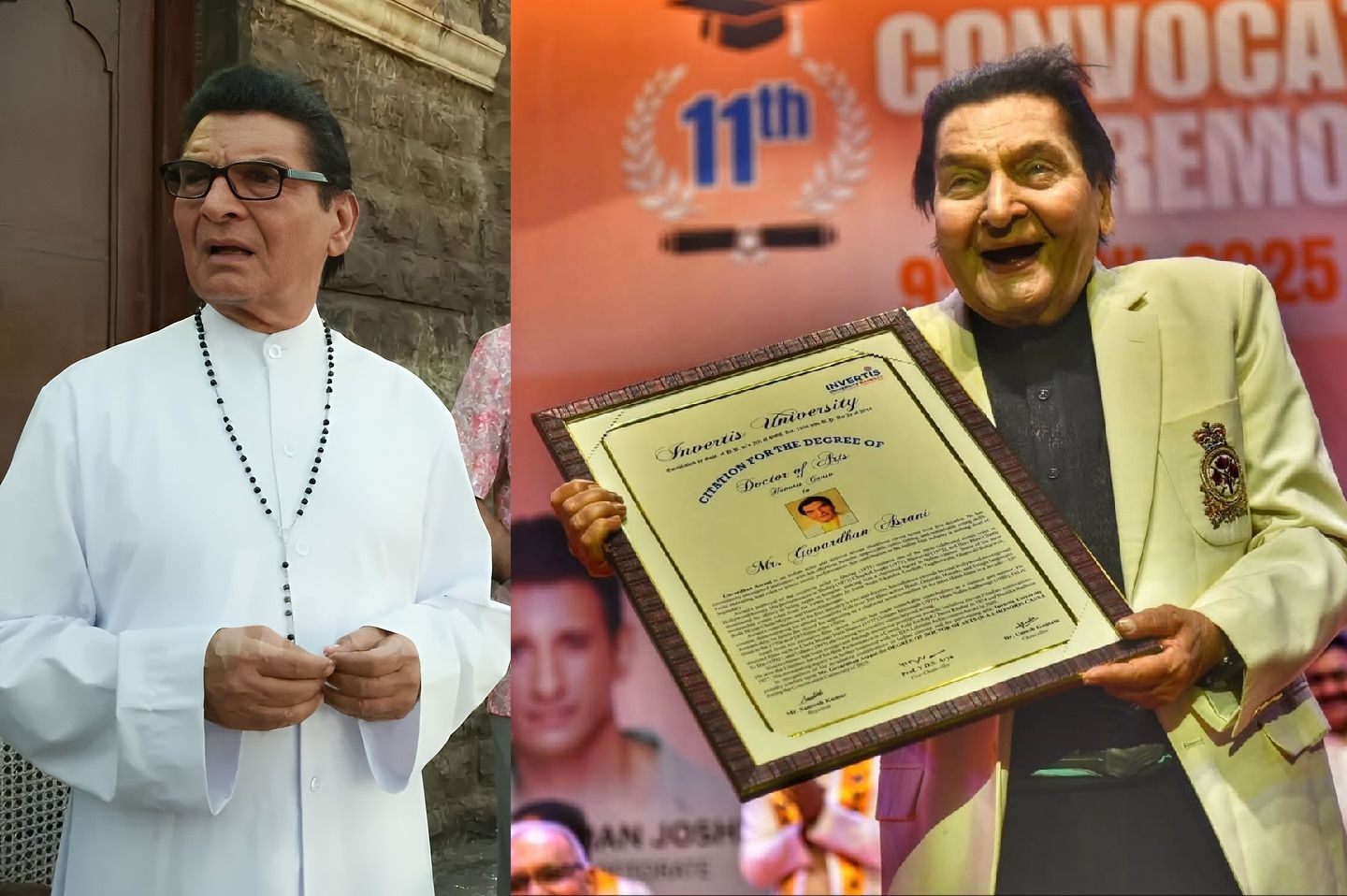
On October 20, 2025, Indian cinema lost one of its most beloved comic actors. Govardhan Asrani, professionally known as Asrani, breathed his last at Arogya Nidhi Hospital in Juhu, Mumbai, at the age of 84. The veteran actor, whose career spanned over five decades and 350 films, passed away after a prolonged illness, with fluid accumulation in his lungs contributing to his deteriorating health.
Just hours before his passing, Asrani had shared a heartfelt Diwali greeting on Instagram, posting "Happy Diwali" with a photo of diyas and rangoli—a poignant final message to his millions of fans. His death marks the end of an era when comedy in Bollywood was rooted in innocence, impeccable timing, and genuine human warmth rather than slapstick.
A Private Farewell: Honoring His Final Wish
In a move that reflected his humble nature, Asrani's last rites were conducted quietly at Santacruz Crematorium at 8 PM on the same evening, attended only by close family members and friends. His manager, Babubhai Thiba, revealed that the private ceremony honored the actor's final wish: "We did not inform anyone about his demise as it was his wish that we should keep it a private thing".
According to reports, Asrani had instructed his wife, actress Manju Asrani, to avoid any public attention or media interaction following his death. Despite being a celebrated figure, he wanted to be remembered as a common man and requested a dignified, quiet departure. The family shared a statement on his Instagram profile that read: "Our beloved, the one who brought smiles to everyone's faces, Asrani ji is no longer among us. His passing is an irreparable loss for both Hindi cinema and our hearts".
The Iconic Jailer Who Became Immortal

While Asrani appeared in over 350 films throughout his illustrious career, one role stands head and shoulders above the rest—the eccentric jailer in Ramesh Sippy's 1975 cult classic Sholay. His character, modeled after Charlie Chaplin's portrayal in "The Great Dictator" (which itself was a spoof on Adolf Hitler), featured a screentime of less than 10 minutes but left an indelible mark on Indian cinema.
The dialogue "Hum Angrezon ke zamaane ke jailer hain" (I am a jailer from the British era) became one of the most quoted lines in Bollywood history. In August 2025, at Sholay's 50th anniversary celebration, Asrani reflected on this iconic role: "As Sholay completes 50 years, I can tell you—there has not been a single function or event where I haven't been asked to recite those dialogues. It's all because of Sippy saab's direction and the writing of Salim-Javed".
Director Ramesh Sippy paid tribute to the late actor, saying, "It's a role he was born to play. But saying all this on a day like this doesn't feel good. It feels maybe that's the best way to remember him". The filmmaker revealed that Asrani was an integral part of creating the character, working collaboratively to bring the comedic jailer to life.
From Jaipur to FTII: The Making of a Legend
Born on January 1, 1941, in Jaipur, Rajasthan, Govardhan Asrani came from a middle-class Sindhi family. His father, who ran a carpet business after migrating from Pakistan during Partition, had little inkling that his son would become a household name in Indian entertainment.
After completing his education at St. Xavier's School in Jaipur, Asrani began his career at All India Radio as a voice artist. Trained in acting under Sahitya Kalabhai Thakkar, he moved to Mumbai in 1962 to pursue his passion for cinema. A chance encounter with filmmaker Hrishikesh Mukherjee proved to be life-changing, leading him to join the prestigious Film and Television Institute of India (FTII) in Pune, from where he graduated in 1966.
However, despite his training, early opportunities were scarce. After appearing in brief roles in films like "Hum Kahan Ja Rahe Hain" and "Satyakam," Asrani found himself struggling to make a mark. To sustain himself, he began teaching at FTII—a move that would unexpectedly pave the way for his breakthrough.
The turning point came when then Information and Broadcasting Minister Indira Gandhi visited Pune. FTII students, including Asrani, complained to her that despite having certificates, nobody in the industry gave them opportunities. Gandhi subsequently came to Mumbai and told producers to hire FTII graduates. This intervention led to Asrani being cast in "Guddi" (1971), which became a hit and legitimized trained acting talent in the industry.
The Hrishikesh Mukherjee Partnership: Cinema's Golden Collaboration

Asrani's creative partnership with legendary director Hrishikesh Mukherjee yielded a harvest of unforgettable characters and is considered one of the most fruitful collaborations in Hindi cinema. They first worked together in "Satyakam" (1969), where Asrani had a brief role. So impressed was Hrishi da that he cast him in a much more pivotal role in "Guddi" the very next year.
In "Guddi," Asrani played the heartbreaking role of a Bollywood struggler whose dreams of stardom are shattered—a character not unlike his own early struggles. In "Bawarchi," he was cast in the comic role of a self-styled musician dreaming of becoming a composer, complete with the memorable song "Namaste Namaste Oh Pitaji".
Hrishikesh Mukherjee once revealed his deep admiration for Asrani in a conversation with film critic Subhash K Jha: "It is neither Rajesh Khanna nor Dharmendra. Not even Amitabh Bachchan. It is Asrani. What a talent, what an actor! Cast him as anyone, anything, and he is ready for the challenge. I get restless when I don't have him in my film".
The director-actor duo collaborated on numerous classics including:
Guddi (1971)
Bawarchi (1972)
Abhimaan (1973)
Chupke Chupke (1975)
Mili (1975)
Alaap (1977)
Jurmana (1979)
The Rajesh Khanna Era: 25 Films of Friendship
Asrani formed a remarkable professional partnership with India's first superstar, Rajesh Khanna, appearing together in 25 films between 1972 and 1991. This collaboration produced classics like "Bawarchi," "Namak Haraam," "Prem Nagar," and "Abhimaan".
In "Abhimaan" (1974), Asrani excelled as star-singer Subir's secretary, who couldn't bear to see his boss turn vain. Amitabh Bachchan once remarked that every scene with Asrani was a challenge, testament to the actor's formidable talent.
Awards and Recognition: Celebrating Excellence in Comedy
Throughout his career, Asrani's contribution to Indian cinema was recognized with numerous accolades. He won the prestigious Filmfare Award for Best Comedian twice: first for "Aaj Ki Taaza Khabar" in 1974 and then for "Balika Badhu" in 1977. These awards honored not only his impeccable comic timing but also his versatility in bringing depth and authenticity to humorous roles.
Beyond these wins, he received multiple Filmfare nominations for performances in films like "Sargam," "Ek Duuje Ke Liye," and "Pati Patni Aur Woh". His work was consistently lauded from his early days through his resurgence in popular comedies in the 2000s, cementing his legacy as one of Bollywood's most beloved comic actors.
The Priyadarshan Renaissance: A Spectacular Second Innings

The new millennium ushered in a spectacular "second innings" for Asrani, largely driven by his prolific collaboration with director Priyadarshan. This partnership proved a masterstroke, reintroducing the veteran comedian to a contemporary audience and cementing his status as an indispensable component of comedy ensembles.
Priyadarshan, known for seamlessly adapting Malayalam hits into Hindi, built a cinematic universe of situational comedy, and Asrani became a recurring, fan-favorite fixture in this world. His memorable roles—often as a flustered uncle, an exasperated landlord, or a bumbling official—showcased his phenomenal range and adaptability across different eras of cinema.
His standout Priyadarshan collaborations include:
Hera Pheri (2000) - The frantic Bank Manager
Garam Masala (2005) - The harried Mamu
Malamaal Weekly (2006) - The eccentric villager Chokhey
Bhagam Bhag (2006) - The flustered Event Manager
Bhool Bhulaiyaa (2007) - The earnest yet funny Murari
De Dana Dan (2009) - The comically named Mamu Lee Chan
Khatta Meetha (2010) - The beleaguered Karodimal
All of these roles highlighted his flawless comic timing and cemented his successful revival in 21st-century comedy.
Beyond Hindi Cinema: The Gujarati Connection
While Asrani is primarily celebrated for his Hindi film work, he enjoyed parallel stardom in Gujarati cinema. He acted as a lead in Gujarati films from 1972 to 1984 and later performed character roles from 1985 to 2012.
His most celebrated contribution to Gujarati culture was the song "Hu Amdavad No Rikshawalo" from the 1974 film "Amdavad No Rikshawalo," sung by Kishore Kumar. The song became an anthem for Ahmedabad and remains beloved to this day. In 2021, it was recreated with Asrani appearing alongside modern Gujarati stars, testament to its enduring popularity.
Asrani achieved success as a lead protagonist in Gujarati films like "Saat Qaidi," "Sansar Chakra," "Pankhi No Malo," "Jugal Jodi," "Maa Baap," and "Chel Chabilo Gujarati". In the 1990s, he continued to contribute to Gujarati cinema in supporting roles.
The Multifaceted Artist: Director and Mentor
Asrani wasn't content with just acting—he also directed six films between 1974 and 1997. His directorial debut, "Chala Murari Hero Banne" (1977), where he also starred as the lead, drew from his own struggles in the film industry. The film featured AK Hangal as his father, a tailor—much like Asrani's real father's profession after Partition.
From 1988 to 1993, he served as a director for the Film Institute in Pune, giving back to the institution that launched his career. His role as a mentor influenced generations of actors who came through FTII's doors. Anupam Kher, in his tribute, noted: "Many people usually know him as a great comic actor, but what many don't know is that he was also a teacher at FTII. He taught many legendary artists".
Personal Life: Love Behind the Scenes
Asrani married actress Manju Asrani (née Bansal), who was mostly active during the 1970s and 80s. The couple fell in love while working on the sets of "Aaj Ki Taaza Khabar" and "Namak Haraam". Manju appeared in several films including "Chandi Sona," "Tapasya," "Jaan-E-Bahaar," "Jurmana," and "Chor Sipahi".
After marriage, Manju continued to act for a while but eventually stepped back from the limelight by the 1980s. In the 1990s, she ventured behind the camera and tried her hand at direction, showing her creative versatility. Despite having the looks and talent to continue acting, Manju prioritized her family over fame and supported Asrani throughout his career.
According to various sources, the couple had a son named Naveen Asrani, who became a dentist practicing in Ahmedabad rather than following his parents into cinema. Asrani reportedly never pressured his son to choose any particular profession, allowing him to pursue his own passion.
Their marriage, based on mutual respect, companionship, and deep love, lasted for over fifty years.
The Art of Comedy: What Made Asrani Special
What set Asrani apart from his contemporaries like Johnny Walker and Mehmood was his unique ability to bring humor without cruelty and always with empathy. His nasal tone, expressive eyes, and impeccable sense of rhythm made him instantly recognizable. Unlike many comic actors of his era, Asrani's comedy was drawn from human frailty rather than exaggerated buffoonery.
In conversations with BBC Hindi, Asrani expressed pride in the recognition he garnered for his comic timing but insisted that he identified as "an artist who finds truth in every role," rather than just a "comedian". This approach allowed him to occasionally venture outside his comedic persona to tackle more serious and complex roles in films like "Moshish" (1972) and "Chali" (1975).
Talking about the evolution of comedy in Indian films, he told Hindustan Times in 2016: "Earlier we had two types of schools of comedy—Bimal Roy school (which was realistic) and Madras school (which was subtle). Bimal Roy never kept comedy out of the story line. Madras comedy was another track but never vulgar".
Tributes Pour In: An Industry Mourns
The news of Asrani's passing triggered an outpouring of grief from the film industry and fans worldwide. Prime Minister Narendra Modi paid tribute, calling him "a gifted entertainer and a truly versatile artist" who "entertained audiences across generations".
Akshay Kumar, who worked with Asrani in multiple films including "Hera Pheri," "Bhagam Bhag," "De Dana Dan," and most recently "Haiwaan," shared an emotional tribute: "Speechless with grief at the passing of Asrani ji. We had just shared the warmest of hugs just a week back at the shoot of Haiwaan. Bahot pyare insaan the...he had the most legendary comic timing".
Anupam Kher recalled his last conversation with the veteran actor: "Dearest #AsraniJi! Thank you for making the world a better place to be in with your persona!! On and off screen! We will miss you in physical form! But cinema and your ability to make people laugh will keep you alive for years to come".
Rajpal Yadav, who frequently worked with Asrani in films like "Bhool Bhulaiyaa" and "Dhol," wrote: "Whether it be Bhool Bhulaiyaa, Dhol, or our last film Bhoot Bangla, your contributions to making all the scenes a hit are special".
Director Ramesh Sippy reflected on their collaboration: "He did a lot of work but this [Sholay] stands out. I will long long remember him. It's a role he was born to play".
The Enduring Legacy
Asrani's journey from a theatre enthusiast in Jaipur to a Bollywood icon is a testament to passion, perseverance, and purpose. His contribution to Indian cinema is immeasurable, not only for the laughter he inspired but also for the emotional honesty he brought to every role.
With a career spanning over five decades and appearances in more than 350 films, Asrani witnessed and contributed to multiple eras of Indian cinema. From the golden age of the 1970s through the evolution of comedy in the 2000s, he remained relevant, adapting his craft while staying true to his roots in character-driven, empathetic humor.
His most recent work included "Non Stop Dhamaal" (2023) and the unreleased "Haiwaan" and "Bhoot Bangla," both featuring Akshay Kumar. Even in his final years, Asrani continued to work, bringing joy to audiences and mentoring younger actors on set.
A Final Bow
As the curtain falls on this remarkable life, Indian cinema loses more than just a comic actor—it loses a cultural icon who helped define what authentic, heartfelt comedy could be. Asrani's performances remain ageless reminders of a golden period when laughter reflected compassion, humility, and humanity.
His iconic lines will continue to be quoted, his memorable characters will be revisited by new generations discovering classic Indian cinema, and his influence on the craft of comedy will endure for decades to come. From the unforgettable "Hum Angrezon ke zamaane ke jailer hain" to countless other performances that brought joy to millions, Asrani's legacy is etched permanently in the annals of Indian entertainment.
Frequently Asked Questions
As we bid farewell to this comedy legend, we remember not just the laugher he gave us, but the warmth, authenticity, and artistry he brought to Indian cinema. Govardhan Asrani may no longer be among us, but his spirit lives on in every smile his performances continue to bring. Om Shanti.